BELOW THE VISIBLE
Four Microworlds
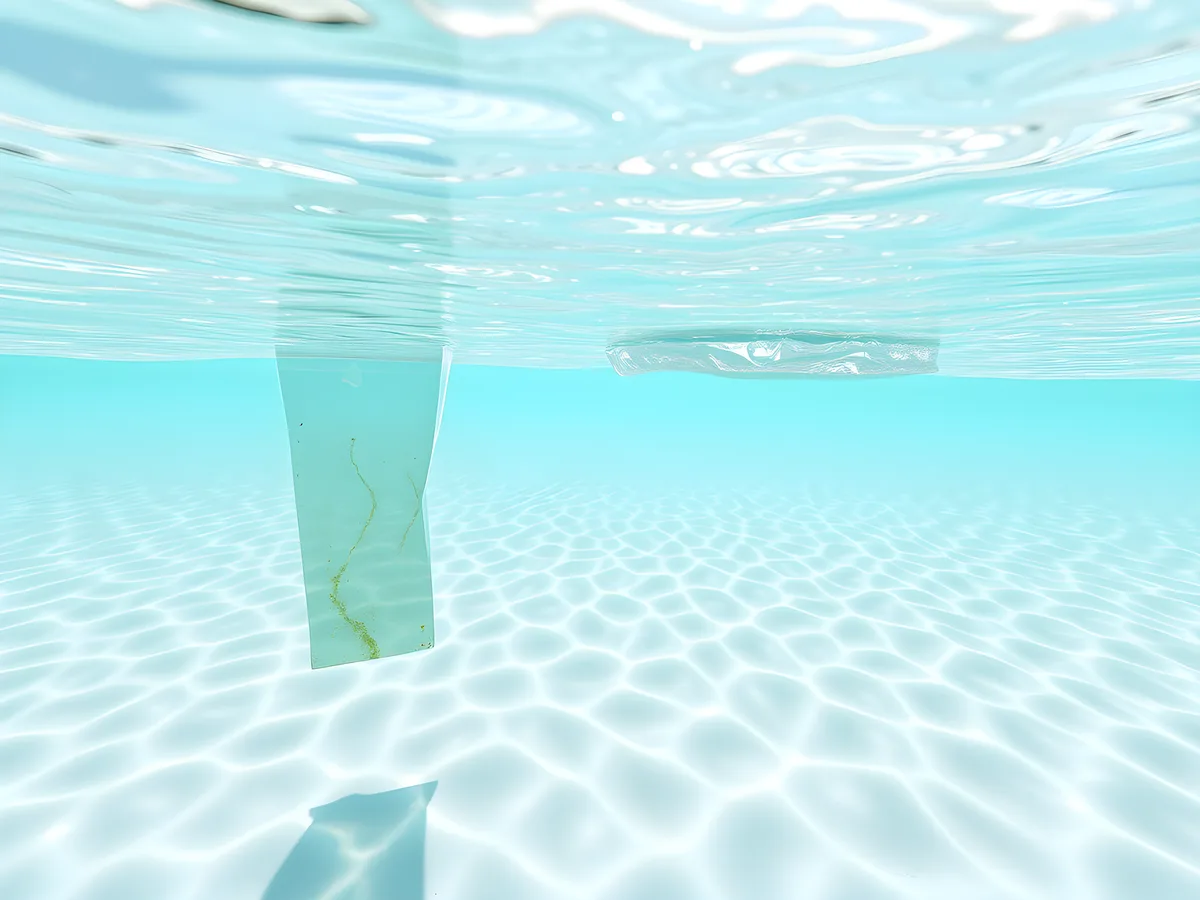
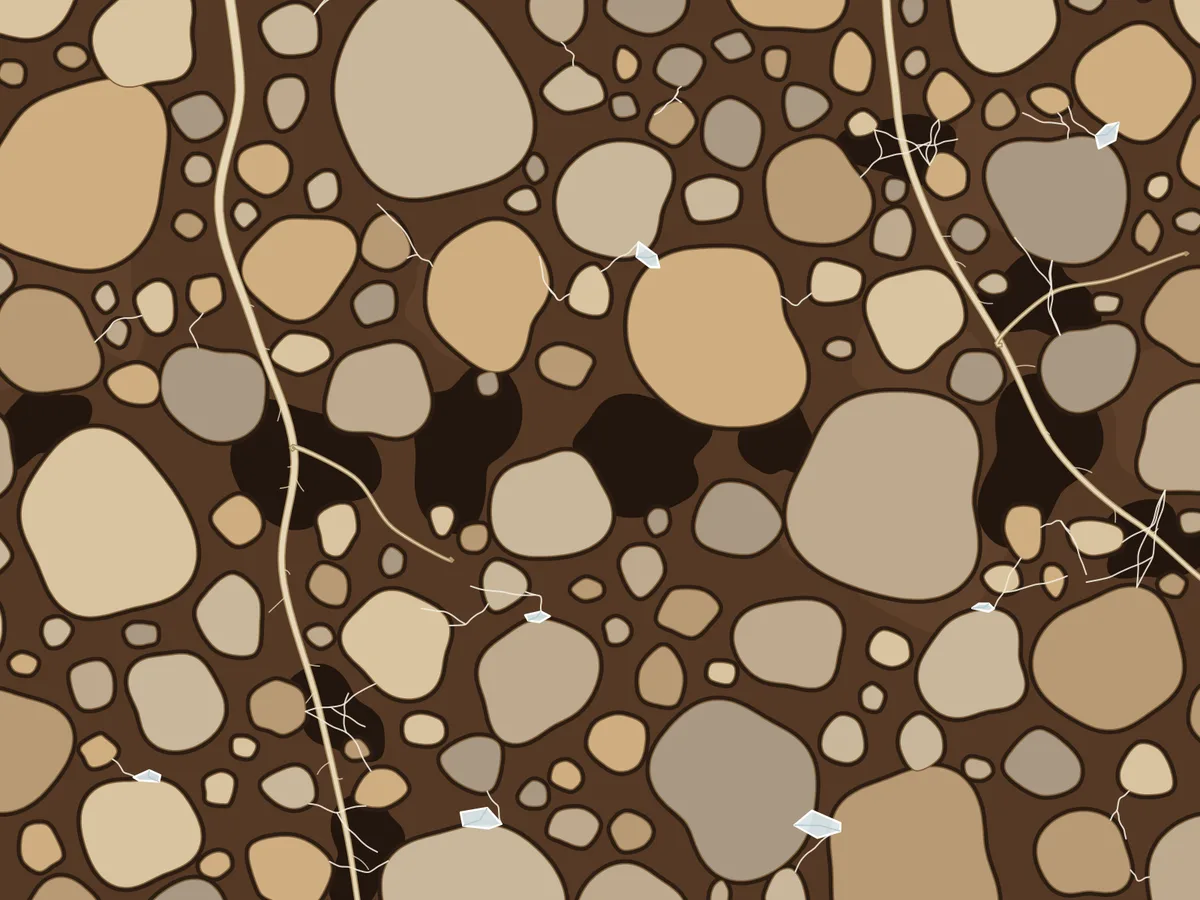
Air, water, soil and lung tissue move and hold plastic particles by different processes: settling and turbulence, buoyancy and biofilm, pore entrapment and surface charge, size-dependent deposition. The four home panels illustrate these with enlarged particles; the air, water and lung panels carry model-estimate counters, and soil has none.
Each medium sorts particles by its own rules. In air, settling competes with wind, turbulence and rain, and shape changes how fast a particle falls. In water, buoyancy decides first and living films may change the outcome. In soil, narrow pores and charged mineral surfaces can hold particles back. In the lung, size decides where an inhaled particle lands. In breathing experiments, particles about 0.5 µm across deposited least of all (level B)1.
That size is too large to diffuse quickly and too small to settle quickly. The four panels on the home page illustrate these processes. They do not record real particles.
≈0.5 µm
particle size the human lung catches least efficiently
total deposition in healthy adults breathing monodisperse test aerosols at controlled patterns; aerosol particles in general, not plastic-specific1
B: a review of several human deposition studies, all showing the minimum; its depth shifts with breathing pattern
BWell supportedup to 76%
slower settling of model fibers than spheres of the same volume
laboratory settling in air of 3D-printed acrylic fibers 0.5–2 mm long (length 20–100 times the diameter) versus volume-equivalent spheres2
C: one laboratory study; the long-range transport that follows is a model estimate
CLimited≈0.6 µm
harmonic mean thickness of the air-blood tissue barrier
morphometry of lungs of young healthy adults (70 kg); arithmetic mean about 1.6 µm; alveolar surface about 130 m²3
C: one classic morphometric dataset; thickness is not a size cutoff for passage
CLimitedWhat the four panels are
The home page shows four panels: air, water, soil and lung tissue. Each combines a still background made with an AI image generator and particles drawn live by the page's code, which drift, sink, lodge or move with a breathing rhythm. The particles are enlarged far beyond true scale so that the motion is visible.
Beside the air, water and lung panels a counter adds up mass from a named study value chosen in settings (for the human body, an intake estimate); it is an estimate, not a measurement, explained in Flows & Model. The soil panel has no counter: we found no sourced global estimate of plastic entering soil. The panels show which process dominates in each medium, so that the numbers on the system pages make physical sense.
What controls particles in each microworld
Data table
| label | value | unit | conditions | level | source |
|---|---|---|---|---|---|
| air | settling, wind and turbulence, and dry and wet deposition decide how long particles stay aloft | shape: model fibers settled up to 76% slower than same-volume spheres; the lung's 0.5 µm minimum is not a rule for open air | B (processes); C (fiber result) | S-283, S-049 | |
| water | buoyancy first: polyethylene and polypropylene float, yet reach deep sediment traps and sediments | biofouling may sink particles (model); disputed for particles of 100 µm or less, where marine snow and ingestion are proposed instead | B (deep finds); C (model); D (small-particle sinking) | S-278, S-277 | |
| soil | entrapment in narrow pore channels and adsorption to grain surfaces | charged iron and aluminum sites may impede migration; in one cited study smaller particles stayed better dispersed yet moved less; controls: particle, flow, porous medium, co-transported substances | C (mechanisms); B (groups of controls) | S-279, S-280 | |
| lung tissue | size-dependent deposition: total deposition lowest near 0.5 µm; diffusion dominates below 0.5 µm, sedimentation at 1–8 µm, impaction mainly above 5 µm | therapeutic aerosols: above about 6 µm mainly upper airway, below about 2 µm mainly alveolar; shifts with breathing, density and shape; fibers also deposit by interception | B (mechanisms, minimum); C (regional cutoffs) | S-281 |
Air: shape decides how far a particle drifts
Particles leave the air by settling, by wind and turbulence carrying them to surfaces, and in rain or snow; transport models and field samplers track this dry and wet deposition (level B)2,8. The lung's 0.5 µm minimum was measured in breathing experiments and is not a rule for open air (level P)1.
In laboratory tests, 3D-printed model fibers 0.5–2 mm long settled up to 76% slower than same-volume spheres; a transport model then found 1 mm fibers more likely than spheres to reach the high Arctic (level C, model estimate)2. In western US protected areas, dry-deposited plastic was smaller than plastic washed out by rain (level C)8.
 Illustration
Water: floating, sinking and the biofilm dispute
Polyethylene (PE) and polypropylene (PP) float in seawater, yet both turn up in deep sediment traps and deep-sea sediments (level B)5. One explanation is biofouling. A 2017 model by Kooi and colleagues added biofilm growth to settling: depending on size and density, particles floated, sank to the seafloor or oscillated up and down, with small particles collecting at intermediate depths (level C, model estimate)4.
The small-particle case is disputed. Benner and Passow (2024) argue that particles of 100 µm or less cannot host the heavy organisms needed to sink, and point to marine snow and ingestion instead (level D)5.
 Illustration
Soil: pores trap and charges may hold
A 2024 review of porous media notes that particles can enter fine pores but can also be trapped in narrow channels (straining), and that attraction between positively charged iron and aluminum sites and negatively charged plastic may impede migration (level C)6. Size alone gives no simple rule: the review reports a study in which smaller particles stayed better dispersed yet moved less (level C)6.
A second review sorts the controls into particle, flow and porous-medium properties, plus co-transported substances (level B)7. In a greenhouse experiment, earthworms carried polyethylene beads down the soil profile, and smaller beads were moved down more (level C)9.
 Illustration
Lung tissue: a thin wall and size-sorted deposition
The panel shows alveoli, the lung's gas-exchange sacs. In young healthy adults the air-blood tissue barrier has a harmonic mean thickness of about 0.6 µm (level C)3; thinness is not a size cutoff for passage. Inhaled therapeutic aerosols above about 6 µm deposit mainly in the upper airway, those below about 2 µm mainly in the alveolar region (level C)1.
These are tendencies, not limits for plastic fragments or fibers. The review does not say whether its diameters are aerodynamic; impaction also depends on density, and fibers deposit by interception, negligible for spheres (level B)1. Deposition is exposure only; uptake is covered on Human Body.
 Illustration
Limitation
The panels are not microscopy and not recordings of real samples. Backgrounds are AI illustrations, particles are drawn by code and enlarged far beyond true scale, and the lung panel shows no real person's tissue. Particle paths are scripted for legibility, not computed by a transport model. The counters are estimates, not measurements, and the soil panel has none.
Where to go next
Amounts and evidence for each medium are on Atmosphere, Oceans, Soil and Human Body. The same scales in one continuous zoom are in From Planet to Cell.
Gallery
 Illustration
Sources
- Darquenne C (2012). Aerosol Deposition in Health and Disease. Journal of Aerosol Medicine and Pulmonary Drug Delivery 25(3):140–147. doi:10.1089/jamp.2011.0916 review open access
- Tatsii D, Bucci S, Bhowmick T, Guettler J, Bakels L, Bagheri G et al. (2024). Shape Matters: Long-Range Transport of Microplastic Fibers in the Atmosphere. Environmental Science & Technology 58(1):671–682. doi:10.1021/acs.est.3c08209 journal article open access
- Weibel ER (2009). What makes a good lung?. Swiss Medical Weekly 139(27–28):375–386. doi:10.4414/smw.2009.12270 review open access
- Kooi M, van Nes EH, Scheffer M, Koelmans AA (2017). Ups and Downs in the Ocean: Effects of Biofouling on Vertical Transport of Microplastics. Environmental Science & Technology 51(14):7963–7971. doi:10.1021/acs.est.6b04702 journal article open access
- Benner I, Passow U (2024). Why biofouling cannot contribute to the vertical transport of small microplastic. Microplastics and Nanoplastics 4:19. doi:10.1186/s43591-024-00098-2 journal article open access
- Zeng L, Yuan C, Xiang T, Guan X, Dai L, Xu D et al. (2024). Research on the Migration and Adsorption Mechanism Applied to Microplastics in Porous Media: A Review. Nanomaterials 14(12):1060. doi:10.3390/nano14121060 review open access
- Li F, Huang D, Wang G, Cheng M, Chen H, Zhou W et al. (2024). Microplastics/nanoplastics in porous media: Key factors controlling their transport and retention behaviors. Science of The Total Environment 926:171658. doi:10.1016/j.scitotenv.2024.171658 review
- Brahney J, Hallerud M, Heim E, Hahnenberger M, Sukumaran S (2020). Plastic rain in protected areas of the United States. Science. doi:10.1126/science.aaz5819 journal article
- Rillig MC, Ziersch L, Hempel S (2017). Microplastic transport in soil by earthworms. Scientific Reports 7:1362. doi:10.1038/s41598-017-01594-7 journal article open access
Evidence levels and provenance
- AConsensus
- Multiple independent studies or a systematic review plus a statement by a scientific body.
- BWell supportedUsed on this page
- Several independent studies with concordant findings.
- CLimitedUsed on this page
- Few studies, narrow conditions, or methodological caveats.
- DDisputedUsed on this page
- Conflicting results; both sides are shown.
- EUnknown
- No reliable evidence found; the search scope is stated.
- PProvenanceUsed on this page
- Provenance: checked against the primary record. A separate category, not an evidence grade: used for bibliographic facts, legal texts, official metadata, definitions quoted from a standard, the site's own arithmetic and statements about the site's process.
Editorial categories of this site. A–E grade scientific findings, per claim, with a one-line rationale; D and E are not lower rungs of the A–C scale. P is not a grade: it marks facts checked against their primary record.