BELOW ONE MICROMETER
What Is Nanoplastic
A nanoplastic is a plastic particle smaller than 1 µm, although some agencies put the line at 100 nm and the EU microplastics restriction sets no lower size limit. This page explains where the size lines are drawn, how nanoplastics form and why smaller particles behave more like colloids than like litter.
A nanoplastic is a piece of plastic smaller than 1 µm, one thousandth of a millimeter. This site draws the line there, following two definition papers; some agencies use 100 nm. Nothing switches on at 1 µm1. As particles shrink, gravity matters less, molecular jostling more, and the molecules they collect steer them. Cut one 1 mm cube of plastic into 100 nm cubes and you get a trillion pieces with 10,000 times the surface (our calculation, below).
1 µm
upper size limit of nanoplastics used on this site
1 nm to <1,000 nm; proposed by Gigault et al. 2018 and Hartmann et al. 20192,3
a convention, not a natural boundary; graded P because it is a definition checked against the two papers
PProvenance100 nm
upper limit in the EU nanomaterial definition (any material) and in EFSA's 2016 nanoplastic range
Commission Recommendation of 10 June 2022: at least 50% of a material's particles by number with one or more external dimensions of 1–100 nm, plus further conditions; EFSA 2016 statement on food4,5
legal and agency texts, read in the original; the EU test classifies a material, not a single particle
PProvenance0.1 µm
temporary enforcement floor of the EU microplastics restriction, which itself has no lower size limit
REACH Annex XVII entry 78 (Regulation (EU) 2023/2055); 0.3 µm for fiber-like particles; applies until methods can quantify smaller particles6,7
stated in the Commission's explanatory guide, version 1.1
PProvenanceEstimate
Our calculation: a cube 1 mm on each side has a surface of 6 mm². Cut it into cubes 100 nm on each side and you get 10,000 × 10,000 × 10,000 = one trillion pieces. Each has a surface of 0.00000006 mm², so together they expose 60,000 mm², which is 10,000 times more. Mass and volume do not change. For polystyrene (about 1.05 g/cm³) the cube weighs about 1 mg.
Where the size lines are drawn
The word "microplastics" took hold after 2004, when Richard Thompson and colleagues reported microscopic plastic fragments and fibers in marine sediments and plankton, without defining the term8,3. Twenty years later they call it the first publication to use the term (level P)9.
The upper bound came from a NOAA workshop in September 2008, whose participants "defined microplastics as plastic particles smaller than 5mm" and required no lower bound. They kept visible particles in the class on purpose, because research was at an early stage (level P)10.
No physical law fixes these lines. Hartmann and colleagues call the 5 mm limit only "somewhat biologically informed" and name classes after metric units3. This site combines two conventions: nanoplastics from 1 nm to below 1,000 nm, as in Gigault et al. and Hartmann et al., and microplastics from 1 µm to 5 mm, keeping the NOAA bound (level P)2,3,10.
Definitions also differ on which dimension counts. Hartmann and colleagues propose the largest one and, for fibers, ask each study to state its choice3. The EU nanomaterial test needs one external dimension in range. REACH entry 78 needs all dimensions at 5 mm or less, or a fiber-like length of 15 mm or less (level P)4,6. This site reports the dimension a cited study used.
| Who | Nanoplastic | Microplastic | Other classes | Note |
|---|---|---|---|---|
| This site | 1 nm to <1 µm | 1 µm–5 mm | none | nano limit from Gigault and Hartmann; 5 mm from NOAA |
| NOAA workshop, 200810 | not defined | below 5 mm | none | no lower bound required |
| EFSA, 20165 | about 1–100 nm | 0.1–5,000 µm | none | food safety statement |
| Gigault et al., 20182 | 1–1,000 nm | not defined | none | unintentionally produced, colloidal behavior |
| Hartmann et al., 20193 | 1 to <1,000 nm | 1 to <1,000 µm | mesoplastics 1 to <10 mm; macroplastics ≥ 1 cm | optional split at 100 nm; largest dimension counts |
| ISO 24187:202311 | no class | 1–1,000 µm | large microplastics 1–5 mm | taken from ISO/TR 21960:2020, modified |
| EU nanomaterial definition, 2022, simplified4 | 1–100 nm in at least one external dimension (any material) | not covered | none | a test of a material's number-based size distribution; see the note below the table |
| EU REACH entry 78, 20236 | no lower size limit | all dimensions ≤ 5 mm; fiber-like ≤ 15 mm long | none | "synthetic polymer microparticles": size alone does not decide scope |
The EU nanomaterial row is a summary. The full definition counts particles on their own and as identifiable parts of aggregates or agglomerates. It also covers elongated particles (two dimensions below 1 nm, one above 100 nm) and plate-like ones (one below 1 nm, two above 100 nm). A material with a volume-specific surface area below 6 m²/cm³ is excluded (level P)4.
REACH entry 78 is narrower in substance and wider in size. Its "synthetic polymer microparticles" are solid polymers that make up at least 1% of a particle's weight or coat it; natural unmodified, degradable, soluble and carbon-free polymers are excluded. The sales ban has derogations and transition periods and does not cover particles formed unintentionally, such as packaging fragments (level P)6. Details are on Policy & regulation.
Entry 78 sets no lower size limit, so it can reach particles a few nanometers across. Its 0.1 µm floor (0.3 µm for fiber-like particles) is temporary and for enforcement only, until methods can quantify smaller particles (level P)6. And a 500 nm particle is a nanoplastic here, a microplastic for EFSA, and below every named class in ISO 24187 (level P)11,5.
Where nanoplastics sit on the size scale
Data table
| label | value | unit | value_max | kind | source |
|---|---|---|---|---|---|
| typical soluble protein | 3 | nm | 6 | reference | S-222 |
| bacteriophage virus | 70 | nm | reference | S-222 | |
| EU nanomaterial upper limit; EFSA nanoplastic upper limit | 100 | nm | threshold-alternative | S-213, S-009 | |
| REACH temporary enforcement floor (fiber-like 300 nm) | 100 | nm | threshold-regulatory | S-214 | |
| this site: nano below, micro above | 1000 | nm | threshold-site | S-005, S-004 | |
| E. coli bacterium (width to length) | 1000 | nm | 2000 | reference | S-222 |
| red blood cell diameter | 7000 | nm | 8000 | reference | S-222 |
| smallest sand grain | 62500 | nm | reference | S-223 | |
| human hair, average diameter | 70000 | nm | reference | S-231 | |
| plankton net mesh used for floating microplastics | 333000 | nm | reference | S-212 | |
| ISO 24187: microplastic ends, large microplastic begins | 1000000 | nm | threshold-iso | S-003 | |
| largest sand grain | 2000000 | nm | reference | S-223 | |
| upper limit of microplastics (NOAA 2008, this site, REACH) | 5000000 | nm | threshold-site | S-212, S-214 | |
| Hartmann et al.: mesoplastics end, macroplastics begin | 10000000 | nm | threshold-alternative | S-005 |
Shapes and polymers
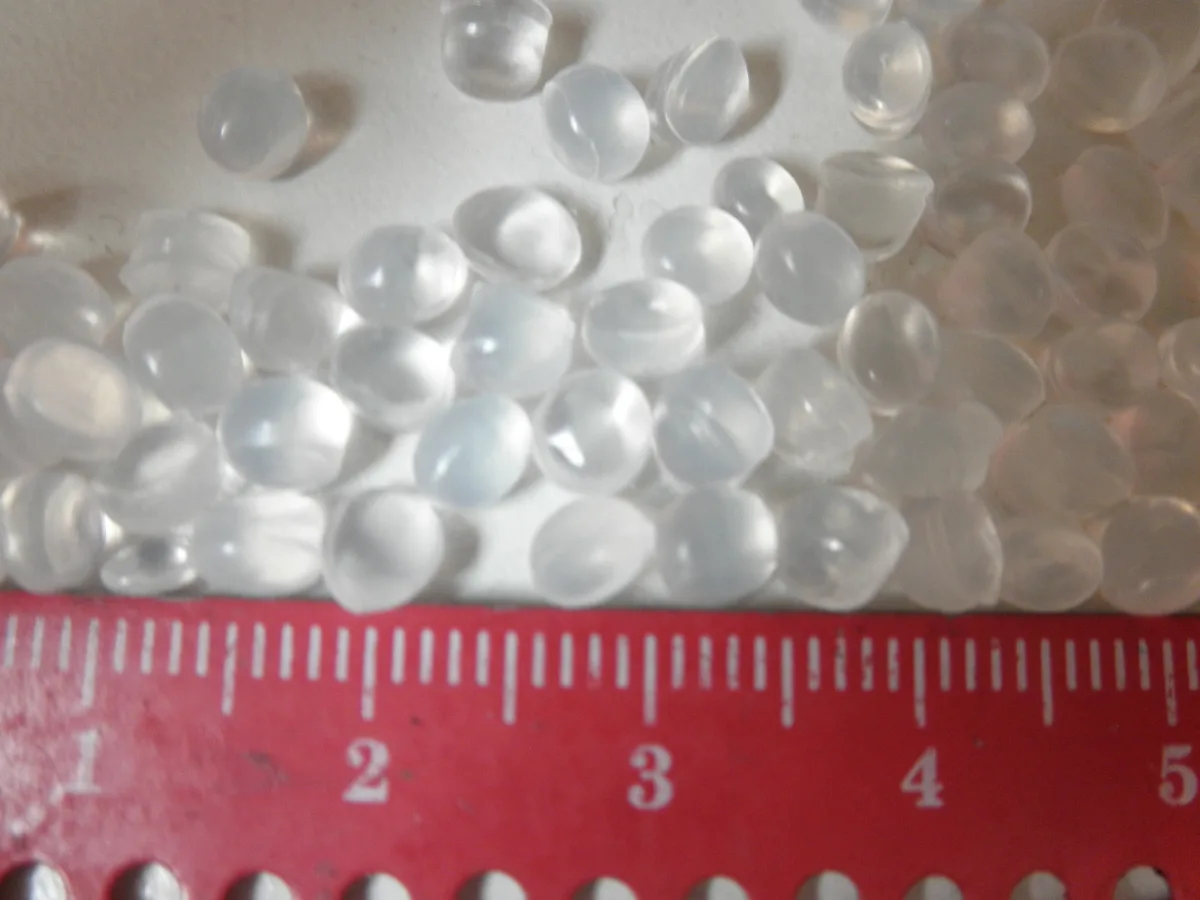
Shape labels vary. Hartmann and colleagues list spheres, beads, pellets, foams, fibers, fragments, films and flakes, noting that the first three are often synonyms. They prefer "irregular particles" to "fragments", because some cosmetic abrasives are made irregular (level P)3. On this site "fragment" means only an irregular piece broken off a larger item.
Common polymers include polypropylene (PP), polyethylene (PE), polyvinyl chloride (PVC), polystyrene (PS), polyethylene terephthalate (PET) and polyurethane (PU)15; polyamide (PA, nylon) appears in the teabag example below16. Density decides first whether a particle floats: PP and PE are lighter than water, solid PS, PVC and PET heavier (level B)17.
Tire wear particles are a borderline case. Tires usually contain 40–60% synthetic polymers, and some polymer chemists do not count rubber as plastic; Hartmann and colleagues propose including them3. Kole and colleagues compile emission estimates averaging 0.81 kg per person per year worldwide (estimate, level C)18. This site states whether a cited study counts them.
Common plastics by density, compared with water
How this was calculated
Polymer ranges from the review table of Wu et al. 2020. Water densities are our calculation with the TEOS-10 equation of state (GSW toolbox): pure water 0.998 g/cm³ at 20 °C; seawater of absolute salinity 35 g/kg at the sea surface 1.025 g/cm³ at 20 °C, 1.023 at 25 °C and 1.028 at 0 °C.
Data table
| label | value | unit | value_max | source | kind | value_min |
|---|---|---|---|---|---|---|
| polypropylene (PP) | 0.9 | g/cm³ | 0.91 | S-221 | ||
| polyethylene (PE) | 0.92 | g/cm³ | 0.97 | S-221 | ||
| pure water at 20 °C (reference line) | 0.998 | g/cm³ | S-225 | reference | ||
| seawater at the surface, salinity 35 g/kg: 20 °C (reference line), range from 25 °C to 0 °C | 1.025 | g/cm³ | 1.028 | S-225 | reference | 1.023 |
| polystyrene (PS), solid | 1.04 | g/cm³ | 1.1 | S-221 | ||
| polyvinyl chloride (PVC) | 1.16 | g/cm³ | 1.58 | S-221 | ||
| polyethylene terephthalate (PET) | 1.37 | g/cm³ | 1.45 | S-221 |
How nanoplastics form
Primary particles are made at their final size, such as pre-production pellets and microbeads; secondary particles form from larger items by fragmentation or wear and tear3. Primary nanoplastics exist too, such as the 0.2 µm polystyrene beads used as model particles20. Gigault and colleagues reserve the word for unintentionally produced particles, which by our reading excludes such beads2.
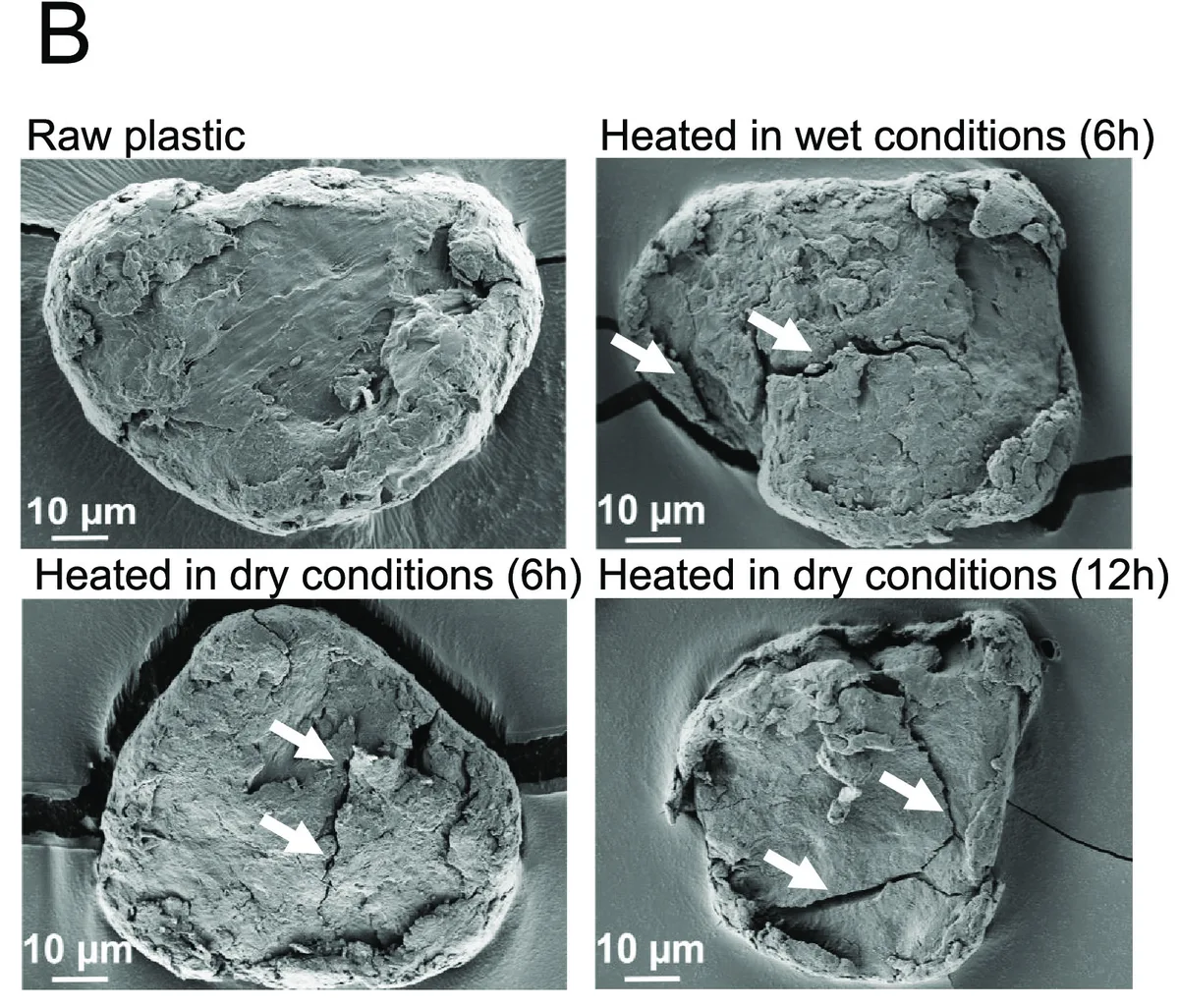
Sunlight drives much of the breakdown. Lambert and Wagner kept pieces of a polystyrene coffee-cup lid in water under visible and UV light at 30 °C. After 56 days the water held about 126 million particles per milliliter, average size 224 nm, against 41 million in controls (level C)21. Their counting method does not identify the polymer.
Not all the mass lost stays particulate. Pfohl and colleagues aged cryo-milled polyamide and polyurethane powders under UV light. Dissolved organic compounds, which are molecules rather than particles, made up a major share of the mass lost, alongside fragments down to 10 nm (level C)22.
Heat can also shed particles, but the best-known example is disputed (level D). Hernandez and colleagues steeped plastic teabags at 95 °C and reported about 11.6 billion "microplastics" and 3.1 billion "nanoplastics" per cup. They matched the dried residue to nylon and PET by spectroscopy16. Their nano line was 100 nm, and only about 2.3 million particles exceeded 1 µm; by this site's convention nearly all would be nanoplastics, if they are plastic23.
Busse and colleagues, including a scientist of Germany's Federal Institute for Risk Assessment (BfR), argue that drying the extract let dissolved oligomers precipitate and be counted as particles24,23. Identifying single particles by Raman spectroscopy, they found 5,800–20,400 plastic particles above 1 µm per bag, apparently washed off its surface rather than shed by brewing23.
Hernandez and colleagues reply that their submicrometer counts come from nanoparticle tracking analysis of the liquid, without drying, and that the two studies used methods that cannot be compared25. BfR's 2025 assessment holds that the reply does not answer the main criticism23. What this means for everyday choices is on What you can do.
Why smaller particles behave more like colloids
Small particles have more surface for their mass. For a sphere or a cube, surface divided by volume equals six divided by the diameter or edge, so it rises tenfold for each tenfold drop in size. Mitrano and colleagues expect no stepwise change at the nanoscale. Surface processes such as pollutant adsorption may still matter more as a given mass is cut smaller1.
Gravity loses its grip gradually. In still water at 20 °C, an isolated polystyrene sphere 10 µm across sinks about 10 mm per hour and one of 1 µm about 0.1 mm per hour. One of 100 nm needs about 110 years per meter. Across solid polystyrene densities that is 57 to 139 years (our calculation, see the method note, level P).
Collisions with water molecules, called Brownian motion, also move particles. Their spread grows with the square root of time, settling in proportion to it. In one hour the 1 µm sphere sinks about 100 µm and wanders about 56 µm along one axis. The 100 nm sphere sinks about 1 µm and wanders about 180 µm (our calculation, level P). Gigault and colleagues make colloidal behavior part of their definition2.
Real particles rarely stay single, so even particles far below 1 µm can leave suspension. Nanoplastics clump with each other (homoaggregation) or with natural particles (heteroaggregation), and the clumps can settle or stick to soil and sediment grains (level B)27. Inside a heteroaggregate, a nanoplastic goes where the larger clump goes1.
In water, natural organic matter and microbial secretions coat nanoplastics in an "eco-corona" that changes their surface and fate (level B)28. In biological fluids proteins form a similar corona; Monopoli and colleagues argue, from engineered nanoparticles, that this coat is what cells meet (level B)29.
Size also affects which barriers a particle passes in laboratory systems. Li and colleagues grew wheat and lettuce in hydroponic and sand culture with fluorescent polystyrene beads. Beads of 0.2 µm entered roots through cracks where lateral roots emerge and reached the shoots; 2 µm beads took that route more slowly (level C)20.
Nanoplastic particles have not yet been extensively measured in the environment, so Mitrano and colleagues compare them with engineered nanomaterials and natural colloids to anticipate their fate1. The human body is covered on Human body.
Same mass, smaller pieces: number and total surface of one 1 mm cube
How this was calculated
Our calculation: number = (1 mm / edge)³; total surface = number × 6 × edge². Ideal cubes, no mass lost to dissolution. The cited source supports why surface area matters (adsorption); the numbers are arithmetic, not data.
Data table
| label | value | unit | surface_mm2 |
|---|---|---|---|
| 1 mm | 1 | pieces | 6 |
| 100 µm | 1000 | pieces | 60 |
| 10 µm | 1000000 | pieces | 600 |
| 1 µm | 1000000000 | pieces | 6000 |
| 100 nm | 1000000000000 | pieces | 60000 |
| 10 nm | 1000000000000000 | pieces | 600000 |
Method
How we computed the settling and Brownian numbers: Stokes' law for one smooth polystyrene sphere (1.05 g/cm³; 1.04–1.10 g/cm³ for the range) in still pure water at 20 °C, density 0.998 g/cm³ (TEOS-10) and viscosity 1.002 mPa·s (IAPWS formulation)19,30. Settling speed is about 2.8 µm/s at 10 µm, 28 nm/s at 1 µm and 0.28 nm/s at 100 nm. Brownian spread is the one-dimensional root-mean-square displacement from the Stokes–Einstein equation, √(2Dt): at 100 nm about 2.9 µm after 1 second and 180 µm after 1 hour. Real particles aggregate, gain coatings and meet currents, so these are idealized estimates, not measurements.
What particles carry
A particle carries chemicals as well as polymer: plasticizers, flame retardants, antioxidants, stabilizers, pigments and fillers15. Plasticizers typically make up 10–70% of a plastic's weight where used, about 80% go into PVC, and phthalates are among the most common (level B)15. EFSA states that microplastics "can contain on average 4%" additives (level C)5. The PlastChem report lists 16,325 known plastic chemicals and flags more than 4,200 as of concern (level P)31.
Particles also sorb pollutants. One study summarized by Hahladakis and colleagues found polychlorinated biphenyls (PCBs) on polypropylene pieces from the sea at 100,000 to 1 million times the surrounding water's concentration (level C)15. Whether a particle harms an organism and whether its chemicals do are separate questions; Human body keeps them apart.
Glossary
- Microplastics
- Plastic particles from 1 µm to 5 mm on this site; ISO 24187 uses 1–1,000 µm.
- Nanoplastics
- Plastic particles from 1 nm to below 1 µm on this site; some authors use 1–100 nm.
- Submicron plastics
- Hartmann et al.'s optional label for 100 nm to below 1,000 nm, used when "nano" stops at 100 nm3.
- Primary plastic particles
- Particles made at their final size, such as pellets, microbeads and laboratory model beads.
- Secondary plastic particles
- Particles formed from larger items by fragmentation or wear and tear.
- Fragment
- An irregular piece broken from a larger item.
- Fiber
- A thread-like particle much longer than it is wide; REACH counts a length-to-diameter ratio above 3 as fiber-like.
- Film, bead
- A thin, flat, flexible particle; a spherical particle, also called a sphere.
- Foam
- A light, porous particle; Hartmann et al. suggest "expanded cellular plastics" as a neutral term.
- Pellets (nurdles)
- Pre-production plastic pellets a few millimeters across, from which products are molded.
- Tire wear particles
- Particles from tire abrasion, mixing synthetic rubber, filler and road material; studies differ on whether they count.
- Oligomer
- A short chain of a few linked monomer units; unlike the polymer, some dissolve in hot water.
- Colloid
- A dispersion of particles small enough that random molecular motion slows their settling; aggregation can still remove them.
- Eco-corona
- A coat of natural organic matter and microbial substances on a particle in the environment; in body fluids, a protein corona.
- Nanomaterial (EU)
- A material in which at least half the particles by number have an external dimension of 1–100 nm, with further conditions4.
Questions
Is a nanoplastic the same as a nanoparticle?
No. "Nanoparticle" covers any particle in the nanometer range, including soot, metal oxides and engineered silver particles. A nanoplastic is made of plastic polymer. The EU nanomaterial definition applies to any material and classifies a sample by its particle size distribution, so a nanoplastic sample may or may not meet it. (level P,4,1)
Do nanoplastics stay suspended forever?
No. An isolated 100 nm polystyrene sphere settles extremely slowly in still water (our calculation), but real nanoplastics aggregate with each other and with natural particles, and the clumps can settle or attach to sediment and soil grains. Water chemistry and surface coatings affect how quickly this happens. (level B,27,28,1)
Do nanoplastics eventually disappear?
How fast nanoplastics break down outside the laboratory has not been measured in the sources reviewed here. Under UV light in one lab study, polyamide and polyurethane powders lost a major share of their mass as dissolved organic compounds, besides fragments down to 10 nm. Rates in soil or deep water remain open. (level C,22)
Where to go next
How scientists find and count particles this small, and why their size limits shape every number, is on How we measure it. The From planet to cell sequence shows the same scale ladder as an animation, and Four microworlds shows particles in air, water, soil and tissue. Laws that use these definitions are on Policy & regulation.
Sources
- Mitrano DM, Wick P, Nowack B (2021). Placing nanoplastics in the context of global plastic pollution. Nature Nanotechnology. doi:10.1038/s41565-021-00888-2 review
- Gigault J, ter Halle A, Baudrimont M, Pascal PY, Gauffre F, Phi TL et al. (2018). Current opinion: What is a nanoplastic?. Environmental Pollution. doi:10.1016/j.envpol.2018.01.024 journal article
- Hartmann NB, Hüffer T, Thompson RC, Hassellöv M, Verschoor A, Daugaard AE et al. (2019). Are We Speaking the Same Language? Recommendations for a Definition and Categorization Framework for Plastic Debris. Environmental Science & Technology. doi:10.1021/acs.est.8b05297 journal article
- European Commission (2022). Commission Recommendation of 10 June 2022 on the definition of nanomaterial (2022/C 229/01). Official Journal of the European Union C 229, 14.6.2022, p. 1–5. eur-lex.europa.eu/legal-content/EN/TXT/?uri=CELEX:32022H0614(01) web open access
- EFSA Panel on Contaminants in the Food Chain (CONTAM) (2016). Presence of microplastics and nanoplastics in food, with particular focus on seafood. EFSA Journal. doi:10.2903/j.efsa.2016.4501 report open access
- European Commission (2025). REACH restriction of synthetic polymer microparticles (Entry 78 of Annex XVII REACH, as introduced by Commission Regulation (EU) 2023/2055): Explanatory Guide, Version 1.1. European Commission (CIRCABC). webgate.ec.europa.eu/circabc-ewpp/d/d/workspace/SpacesStore/7f416aa0-21ab-4b9e-9809-b5d7087c9501/download report open access
- European Commission (2023). Commission Regulation (EU) 2023/2055 of 25 September 2023 amending Annex XVII to Regulation (EC) No 1907/2006 (REACH) as regards synthetic polymer microparticles. Official Journal of the European Union. eur-lex.europa.eu/eli/reg/2023/2055/oj web open access
- Thompson RC, Olsen Y, Mitchell RP, Davis A, Rowland SJ, John AWG et al. (2004). Lost at Sea: Where Is All the Plastic?. Science. doi:10.1126/science.1094559 journal article
- Thompson RC, Courtene-Jones W, Boucher J, Pahl S, Raubenheimer K, Koelmans AA (2024). Twenty years of microplastic pollution research—what have we learned?. Science. doi:10.1126/science.adl2746 review
- Arthur C (ed.), Baker J (ed.), Bamford H (ed.) (2009). Proceedings of the International Research Workshop on the Occurrence, Effects and Fate of Microplastic Marine Debris (September 9–11, 2008). NOAA Technical Memorandum NOS-OR&R-30. National Oceanic and Atmospheric Administration (NOAA), Silver Spring, MD. marinedebris.noaa.gov/live/s3fs-public/publications-files/TM_NOS-ORR_30.pdf report open access
- ISO/TC 61/SC 14 (2023). ISO 24187:2023 Principles for the analysis of microplastics present in the environment. International Organization for Standardization. www.iso.org/standard/78033.html standard
- Milo R, Phillips R (2015). Cell Biology by the Numbers. Garland Science. doi:10.1201/9780429258770 report open access
- Wentworth CK (1922). A Scale of Grade and Class Terms for Clastic Sediments. The Journal of Geology 30(5):377–392. doi:10.1086/622910 journal article
- US Environmental Protection Agency (2026). Particulate Matter (PM) Basics. US EPA, last updated 18 September 2026. www.epa.gov/pm-pollution/particulate-matter-pm-basics web open access
- Hahladakis JN, Velis CA, Weber R, Iacovidou E, Purnell P (2018). An overview of chemical additives present in plastics: Migration, release, fate and environmental impact during their use, disposal and recycling. Journal of Hazardous Materials 344:179–199. doi:10.1016/j.jhazmat.2017.10.014 review open access
- Hernandez LM, Xu EG, Larsson HCE, Tahara R, Maisuria VB, Tufenkji N (2019). Plastic Teabags Release Billions of Microparticles and Nanoparticles into Tea. Environmental Science & Technology. doi:10.1021/acs.est.9b02540 journal article
- Wu M, Yang C, Du C, Liu H (2020). Microplastics in waters and soils: Occurrence, analytical methods and ecotoxicological effects. Ecotoxicology and Environmental Safety 202:110910. doi:10.1016/j.ecoenv.2020.110910 review open access
- Kole PJ, Löhr AJ, Van Belleghem F, Ragas A (2017). Wear and Tear of Tyres: A Stealthy Source of Microplastics in the Environment. International Journal of Environmental Research and Public Health. doi:10.3390/ijerph14101265 review open access
- IOC, SCOR, IAPSO (2010). The international thermodynamic equation of seawater – 2010: Calculation and use of thermodynamic properties (TEOS-10). Intergovernmental Oceanographic Commission, Manuals and Guides No. 56. UNESCO (English). www.teos-10.org/pubs/TEOS-10_Manual.pdf standard open access
- Li L, Luo Y, Li R, Zhou Q, Peijnenburg WJGM, Yin N et al. (2020). Effective uptake of submicrometre plastics by crop plants via a crack-entry mode. Nature Sustainability. doi:10.1038/s41893-020-0567-9 journal article
- Lambert S, Wagner M (2016). Characterisation of nanoplastics during the degradation of polystyrene. Chemosphere. doi:10.1016/j.chemosphere.2015.11.078 journal article
- Pfohl P, Wagner M, Meyer L, Domercq P, Praetorius A, Hüffer T et al. (2022). Environmental Degradation of Microplastics: How to Measure Fragmentation Rates to Secondary Micro- and Nanoplastic Fragments and Dissociation into Dissolved Organics. Environmental Science & Technology. doi:10.1021/acs.est.2c01228 journal article
- German Federal Institute for Risk Assessment (BfR) (2025). BfR assesses study on tea bags and microplastic particles. Communication 029/2025. Bundesinstitut für Risikobewertung, Berlin, 5 August 2025. www.bfr.bund.de/assets/01_Ver%C3%B6ffentlichungen/Mitteilungen_englisch/bfr-assesses-study-on-tea-bags-and-microplastic-particles.pdf report open access
- Busse K, Ebner I, Humpf HU, Ivleva N, Kaeppler A, Oßmann BE et al. (2020). Comment on "Plastic Teabags Release Billions of Microparticles and Nanoparticles into Tea". Environmental Science & Technology 54(21):14134–14135. doi:10.1021/acs.est.0c03182 journal article
- Hernandez LM, Xu EG, Larsson HCE, Tahara R, Maisuria VB, Tufenkji N (2020). Response to Comment on "Plastic Teabags Release Billions of Microparticles and Nanoparticles into Tea". Environmental Science & Technology 54(21):14136–14137. doi:10.1021/acs.est.0c06422 journal article open access
- Sarkar AK, Rubin AE, Zucker I (2021). Engineered Polystyrene-Based Microplastics of High Environmental Relevance. Environmental Science & Technology. doi:10.1021/acs.est.1c02196 journal article open access
- Alimi OS, Farner Budarz J, Hernandez LM, Tufenkji N (2018). Microplastics and Nanoplastics in Aquatic Environments: Aggregation, Deposition, and Enhanced Contaminant Transport. Environmental Science & Technology 52(4):1704–1724. doi:10.1021/acs.est.7b05559 review
- Junaid M, Wang J (2021). Interaction of nanoplastics with extracellular polymeric substances (EPS) in the aquatic environment: A special reference to eco-corona formation and associated impacts. Water Research 201:117319. doi:10.1016/j.watres.2021.117319 review
- Monopoli MP, Åberg C, Salvati A, Dawson KA (2012). Biomolecular coronas provide the biological identity of nanosized materials. Nature Nanotechnology 7(12):779–786. doi:10.1038/nnano.2012.207 journal article open access
- Huber ML, Perkins RA, Laesecke A, Friend DG, Sengers JV, Assael MJ et al. (2009). New International Formulation for the Viscosity of H2O. Journal of Physical and Chemical Reference Data 38(2):101–125. doi:10.1063/1.3088050 journal article
- Wagner M, Monclús L, Arp HPH, Groh KJ, Løseth ME, et al. (2024). State of the science on plastic chemicals: Identifying and addressing chemicals and polymers of concern (PlastChem report and database v1.0). Zenodo (PlastChem project). doi:10.5281/zenodo.10701706 report open access
Evidence levels and provenance
- AConsensus
- Multiple independent studies or a systematic review plus a statement by a scientific body.
- BWell supportedUsed on this page
- Several independent studies with concordant findings.
- CLimitedUsed on this page
- Few studies, narrow conditions, or methodological caveats.
- DDisputedUsed on this page
- Conflicting results; both sides are shown.
- EUnknown
- No reliable evidence found; the search scope is stated.
- PProvenanceUsed on this page
- Provenance: checked against the primary record. A separate category, not an evidence grade: used for bibliographic facts, legal texts, official metadata, definitions quoted from a standard, the site's own arithmetic and statements about the site's process.
Editorial categories of this site. A–E grade scientific findings, per claim, with a one-line rationale; D and E are not lower rungs of the A–C scale. P is not a grade: it marks facts checked against their primary record.