21 LANDMARKS, 2004 TO 2026
Landmark Studies
Twenty-one entries, covering 22 studies from 2004 to 2026, that named microplastics, put numbers on them and followed them into the human body and down to the nanoscale. Each card says what later work confirmed or disputed and how well the key finding holds in November 2026.
Some of the most quoted numbers about microplastics no longer stand as first published. Two 2021 estimates of weekly plastic intake, 0.1–5 g and about 4.1 µg, differ by a factor of about 24,000 to 1.2 million (our calculation) and cover different particle sizes1,2. The blood and brain concentrations behind 2022 and 2025 headlines are disputed on method3,4. That microscopic plastic is widespread at sea has held for two decades5,6.
How we chose these studies
A study is a landmark here if it changed what a field studied, created a method others adopted, set a number still quoted, or triggered a correction. We did not rank by citation counts. The page has 21 entries covering 22 studies, because one card pairs the two weekly-intake estimates.
The list is balanced across air, water, soil and the human body; soil is thinnest because field studies remain scarce. Disputed work is included on purpose, with both sides shown.
Each card gives what was measured, where, sample size, the main number, later changes and the main limitation. The level grades the key finding as of 3 November 2026, not the study's importance: A consensus, B well supported, C limited, D disputed (Evidence Levels). See also How We Measure It and Evidence by System.
Timeline from 2004 to 2026
- 2004Microscopic plastic on UK shores and at sea (Thompson)5
- 2011Shoreline microplastic on six continents; washing fibers (Browne)7
- 2014At least 5.25 trillion floating particles, modeled (Eriksen)8
- 20154.8–12.7 Mt into the ocean in 2010 (Jambeck)9
- 2016Sludge brings microplastic to farmland (Nizzetto)10
- 20178,300 Mt made, 9% of waste recycled (Geyer)11
- 2017First nanoplastic in a natural sample (Ter Halle)12
- 2019Deposition in the remote Pyrenees (Allen)13
- 2019Microplastics in human stool (Schwabl)14
- 2020Deposition at 11 western US protected sites (Brahney)15
- 2020Submicrometer beads enter crop roots (Li)16
- 2020Nanoplastic in Alpine snow (Materić)17
- 2021Microplastics in placenta (Ragusa)18
- 2021Weekly intake: 0.1–5 g versus 4.1 µg (Senathirajah; Mohamed Nor)1,2
- 2022Plastic mass in blood (Leslie)19
- 2024Plastic in carotid plaque and cardiovascular events (Marfella)20
- 2024240,000 particles per liter of bottled water, disputed (Qian)21
- 2025Brain concentrations, disputed (Nihart)22
- 202527 Mt of North Atlantic nanoplastic (ten Hietbrink)23
- 2026Models overestimate airborne microplastic (Evangelou)24
- 2026Plastic in brain tumors and healthy brain (Li)25
Naming and finding microplastics, 2004 to 2014
The first decade was about seeing the problem: picking particles out of sediment and seawater, confirming them as plastic by infrared spectroscopy, and counting them.
Lost at Sea: Where Is All the Plastic?
Thompson and colleagues examined sediments at six sites around Plymouth, UK, and on 17 more British beaches, plus North Atlantic plankton samples archived since the 1960s. Infrared spectroscopy identified nylon, polyester and other polymers; the archive showed a significant increase. In tanks, amphipods, lugworms and barnacles ingested the particles. A 2024 review says the term was first applied to microscopic plastic debris here6. The core finding, microscopic plastic widespread at sea, is now consistently found worldwide. Limitation: UK shores and two plankton routes, counts not mass, smallest particles unidentifiable.
Read the study ↗Accumulation of Microplastic on Shorelines Woldwide: Sources and Sinks
Browne and colleagues found microplastic (here, below 1 mm) on shorelines at 18 sites on six continents, with more near dense populations. Polyester and acrylic fibers occurred in proportions resembling sewage effluent, and a single garment shed more than 1,900 fibers per wash. Later laboratory work found over 700,000 fibers from a 6 kg acrylic load26; per-wash numbers vary with fabric and conditions. Limitation: counts only, and the sewage link was inferred from polymer proportions, not traced.
Read the study ↗Plastic Pollution in the World's Oceans: More than 5 Trillion Plastic Pieces Weighing over 250,000 Tons Afloat at Sea
Eriksen and colleagues combined 680 net tows and 891 visual transects from 24 expeditions (2007–2013) with a dispersal model. They estimated at least 5.25 trillion floating particles weighing 268,940 metric tons, with far fewer small particles than fragmentation predicts. In 2023, pooling 11,777 stations, the same lead author's team estimated about 82–358 trillion particles weighing 1.1–4.9 million metric tons (Mt)27. We grade the numbers C, each being one modeled estimate; widespread floating plastic is not in doubt. Limitation: surface only, nets miss particles below 0.33 mm.
Read the study ↗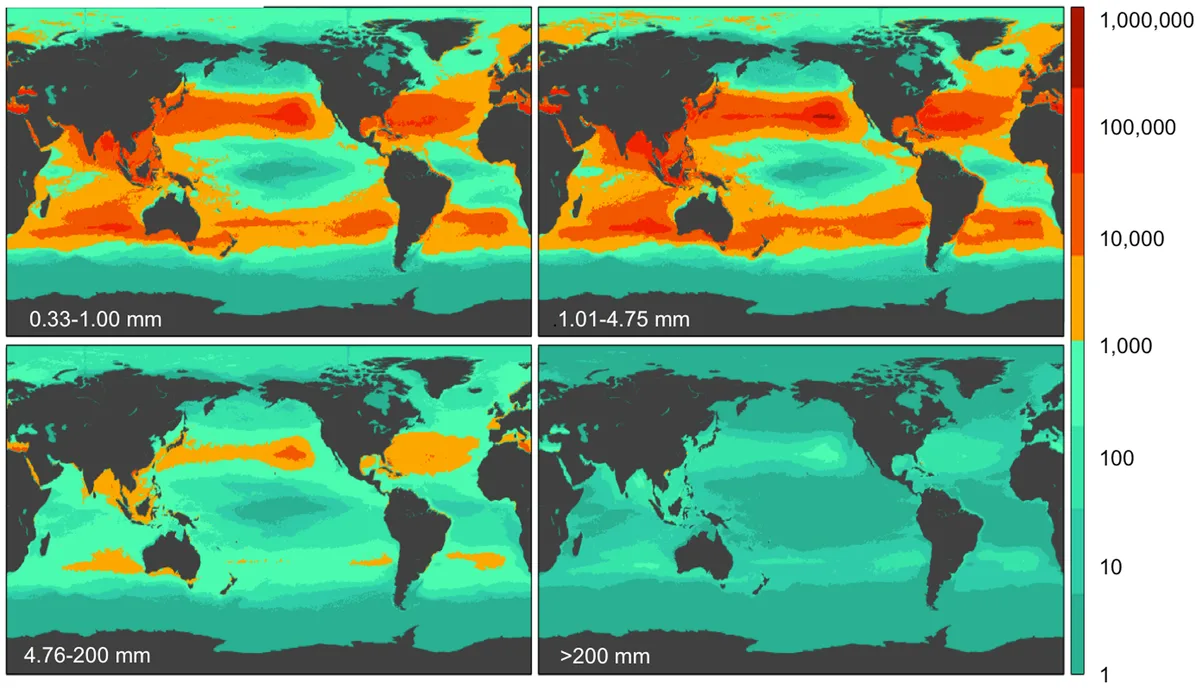
How much and where, 2015 to 2020
With presence at sea settled, the questions turned to budgets and pathways: how much is made, how much escapes, and whether it travels by river, sludge or wind. Most answers are estimates, and later work revised several.
Plastic waste inputs from land into the ocean
Jambeck and colleagues linked waste, population and management data for 192 coastal countries. They estimated 275 Mt of plastic waste generated there in 2010, with 4.8–12.7 Mt entering the ocean. Later models changed the scope: 19–23 Mt into all aquatic ecosystems in 201628, and 0.8–2.7 Mt per year from more than 1,000 rivers29. Limitation: an estimate resting on assumed shares of mismanaged waste reaching the sea, with no measured flux.
Read the study ↗Are Agricultural Soils Dumps for Microplastics of Urban Origin?
In a viewpoint, Nizzetto, Futter and Langaas combined sludge volumes, the share spread on farmland, and microplastic contents of sludge. They estimated that 63,000–430,000 metric tons of microplastics reach European farmland each year, and 44,000–300,000 metric tons North American farmland. Each range exceeds the 93,000–236,000 metric tons then estimated afloat in the oceans. It put soil on the research agenda. Limitation: a theoretical estimate, not checked against measured soil stocks.
Read the study ↗Production, use, and fate of all plastics ever made
Geyer, Jambeck and Law compiled production, use and end-of-life data for resins, fibers and additives. By 2015, they estimated, 8,300 Mt of virgin plastic had been made and 6,300 Mt had become waste: about 9% recycled, 12% incinerated and 79% landfilled or left in the environment. The OECD's 2022 model again put recycling at 9%, with 460 Mt produced in 201930. Limitation: global mass-balance estimates from industry statistics, not tracked flows.
Read the study ↗Atmospheric transport and deposition of microplastics in a remote mountain catchment
Allen and colleagues collected five months of deposition in winter 2017–2018 at the Bernadouze station, 1,425 m up in the French Pyrenees. They counted an average of 365 particles per square meter per day, mostly fragments, from source areas up to 95 km away. The atmosphere became a transport route in its own right; a 2026 compilation holds 2,782 measurements24. The Author Correction only added acknowledgements and fixed a reference. Limitation: one site, one season, counts without mass.
Read the study ↗Plastic rain in protected areas of the United States
Brahney and colleagues sampled deposition at 11 sites in national parks and wilderness areas of the western United States. It averaged 132 particles per square meter per day, scaled to more than 1,000 metric tons per year on the region's protected lands. Wet deposition tracked nearby cities; dry deposition came from farther away. Limitation: the tonnage is an extrapolation from counts, and a global emission estimate later built on western US data31 fed models that overestimate measured air concentrations24.
Read the study ↗Effective uptake of submicrometre plastics by crop plants via a crack-entry mode
Li and colleagues exposed wheat and lettuce to fluorescent polystyrene (PS) beads of 0.2 µm and 2 µm, and to polymethylmethacrylate particles, in hydroponic culture, sand and sandy soil. Particles entered roots through cracks where lateral roots emerge, reached the vascular core and moved up to stems and leaves. Limitation: pristine spherical beads in the laboratory; uptake of weathered particles in working fields is not established.
Read the study ↗Into the human body, 2019 to 2025
From 2019, groups looked for plastic in stool, placenta, blood, arteries and brain. Early studies counted particles by spectroscopy in a handful of samples; later ones reported mass by pyrolysis, the method now at the center of the dispute (see Human Body). Detection is reported consistently; the amounts are disputed, and no study here shows that plastic causes disease.
Detection of Various Microplastics in Human Stool
Schwabl and colleagues collected one stool sample each from eight healthy volunteers in Europe and Asia. Infrared microspectroscopy found microplastics in all eight: a median of 20 particles per 10 g, 50–500 µm across, nine polymer types, mostly polypropylene (PP) and polyethylene terephthalate (PET). It was the first published detection in human stool. Limitation: eight people, one sample each, only particles of 50 µm and larger.
Read the study ↗Plasticenta: First evidence of microplastics in human placenta
Ragusa and colleagues found 12 pigmented particles of 5–10 µm in four of six placentas by Raman microspectroscopy, on fetal and maternal sides. Three were polypropylene; for nine, only the pigments could be identified. A 2024 study using pyrolysis gas chromatography–mass spectrometry (py-GC/MS) reported plastic in all 62 placentas tested, mean 126.8 µg/g, mostly polyethylene32; in blood, that method gives false polyethylene signals3. Limitation: six samples, and most identifications rest on pigments, not polymers.
Read the study ↗Estimation of the mass of microplastics ingested – A pivotal first step towards human health risk assessment
Two 2021 intake estimates differ by a factor of about 24,000 to 1.2 million (our calculation). Senathirajah and colleagues combined particle counts from 59 publications, for particles up to 1 mm, with average particle masses: 0.1–5 g per person per week. The upper end became WWF's 2019 "credit card a week"33. Mohamed Nor and colleagues modeled eight foods and inhalation for particles of 1–5,000 µm: median adult intake 583 ng per day, about 4.1 µg per week (our calculation)2. Pletz argues the 5 g figure is orders of magnitude too high because sizes and masses were combined wrongly34. Limitation: both are estimates with different size windows.
Read the study ↗Discovery and quantification of plastic particle pollution in human blood
Leslie and colleagues applied double-shot py-GC/MS, for particles of 700 nm and larger, to whole blood from 22 healthy donors in the Netherlands. Plastic was quantifiable in 17, mostly PET, styrene polymers and polyethylene (PVC was not targeted), with a mean summed concentration of 1.6 µg/mL, the first mass of plastic reported in blood. Rauert and colleagues later found that blood lipids create false polyethylene signals and matrix suppression makes PET unreliable3. A 2025 follow-up by overlapping authors, with a changed workflow, detected plastic in all 102 samples but quantified it in only 20%, averaging 386 ng/mL35. Limitation: 22 donors, nothing below 700 nm.
Read the study ↗Microplastics and Nanoplastics in Atheromas and Cardiovascular Events
Marfella and colleagues analyzed carotid plaque from 304 surgical patients by py-GC/MS, with supporting electron microscopy and carbon-isotope analysis, and followed 257 for a mean of 34 months. Polyethylene was detected in 150 of the 257 (58%) and PVC in 31. Those with detectable plastic had a higher risk of heart attack, stroke or death (hazard ratio 4.53; 95% CI 2.00–10.27). Hołda and Batko's letter notes no anti-contamination steps beyond glass tubes and no operating-room blanks; the authors' reply was inaccessible to us36. The paper says contamination "cannot be firmly ruled out". Limitation: one cohort, residual confounding, an association.
Read the study ↗Bioaccumulation of microplastics in decedent human brains
Nihart and colleagues analyzed liver, kidney and frontal cortex from New Mexico decedents who died in 2016 or 2024 (20–28 per year group), plus 12 brains from people with dementia. By py-GC/MS, median brain concentration was 4,917 µg/g in 2024 against 3,345 µg/g in 2016, mostly polyethylene, and highest with dementia. These are different people at each date, not accumulation within people, and the authors assume no causal role in dementia. A Matters Arising argues that limited contamination controls, missing validation and incomplete digestion of lipid-rich brain may have inflated the values4. Limitation: one pyrolysis method.
Read the study ↗Limitation
The brain dispute side by side. Challenge: digestion leaves lipid residue that can mimic polyethylene, and controls were limited4. Defense in the paper: infrared spectroscopy of five brains confirmed polyethylene predominance, a second laboratory replicated key results, and reagent and storage blanks were run; the authors note residual biomatrix that could interfere22. The reply discusses "the uncertainties in even the best current methods"; only its opening was accessible to us37. A 2026 paper summarizes its arguments: the lipid comparison mixes dry- and wet-weight percentages, polymers without known lipid interference rose too, and blanks held no detectable polymer38. A March 2025 correction fixed duplicated images and scale bars, added an ethanol step and clarified Supplementary Table 12; no concentration changed39.
The nanoscale arrives, 2017 to 2025
Below 1 µm, particles slip past filters and most spectroscopy. The landmarks here are mostly methods, and each first number carries the limits of the method that produced it.
Nanoplastic in the North Atlantic Subtropical Gyre
Ter Halle and colleagues isolated colloids from North Atlantic subtropical gyre seawater, confirmed nanoscale particles by dynamic light scattering and fingerprinted them by py-GC/MS. The anthropogenic signal matched PVC, PET, PS and polyethylene: the first nanoplastic reported in a natural sample. Later basin-scale measurements support it23. Limitation: polymers were identified but concentrations not reported, and polyethylene signals changed with weathering.
Read the study ↗Micro- and Nanoplastics in Alpine Snow: A New Method for Chemical Identification and (Semi)Quantification in the Nanogram Range
Materić and colleagues adapted thermal desorption–proton transfer reaction–mass spectrometry (TD-PTR-MS) to plastics, detecting below 1 ng of polystyrene in 1 mL samples, about 100 times more sensitive than earlier methods by their comparison. In Austrian Alpine snow they found several microplastic polymers, but only PET in the nanometer range. The method later enabled basin-scale ocean measurements23. Limitation: semi-quantitative, one site, and fingerprints that dissolved organic matter can complicate.
Read the study ↗Rapid single-particle chemical imaging of nanoplastics by SRS microscopy
Qian and colleagues built a stimulated Raman scattering microscope that matches single particles, down to about 100–200 nm, against seven common polymers. Bottled water from three brands bought at one retailer held about 240,000 plastic particles per liter (±130,000), about 90% nanoplastics. The count is disputed: Materić notes that the Milli-Q procedural blanks held about as many particles as the samples40; the authors reply that this water was itself contaminated and so was not a valid blank41. Limitation: three brands, seven polymers, unidentified particles not counted.
Read the study ↗Nanoplastic concentrations across the North Atlantic
Ten Hietbrink and colleagues sampled 12 stations on a November 2020 cruise of RV Pelagia, from the subtropical gyre to the European shelf, surface to seafloor. TD-PTR-MS found 1.5–32 mg/m³ of PET, PS and PVC nanoplastics. Extrapolated from the nine open-ocean stations to the temperate to subtropical North Atlantic mixed layer, this gives an estimate of 27 Mt, rivaling estimates for larger floating plastic. Limitation: one cruise extrapolated to a basin; polyethylene and PP were not detected.
Read the study ↗
Corrections and disputes, 2024 to 2026
From 2024 the field began auditing itself: chemists tested the methods behind tissue headlines, modelers checked emission estimates against measurements, and new tissue studies built in contamination tests. On 13 January 2026 The Guardian said it had identified seven human-tissue studies challenged in published criticism42.
The 2025 blood-method test (Rauert) and the 2026 glove and confidence-level papers are carded on Evidence by System3,43,44.
Atmospheric microplastic emissions from land and ocean
Evangelou, Bucci and Stohl compared 2,782 airborne microplastic measurements from 76 studies at 283 locations (2014–2024) with size-matched model runs. Models driven by three earlier emission estimates overestimated measured median concentrations by two to four orders of magnitude. Measured medians were 0.08 particles/m³ over land and 0.003 over the ocean. After rescaling, land emits about 23 times more particles than the ocean (our calculation), but the ocean dominates by mass. Limitation: particle numbers from methods and size ranges that differ.
Read the study ↗Microplastics and nanoplastics in brain tumours and the healthy human brain
Li and colleagues analyzed 156 samples of tumor and surrounding brain from 113 surgical patients in China, and 35 healthy brain samples from five post-mortem donors. Infrared imaging gave particle counts, py-GC/MS gave mass, including a fraction below 1 µm, and a second infrared method disagreed on 2 of 18 checked particles. A hot-ethanol wash removed a lipid peak before pyrolysis; operating-room air, saline and surgical materials were tested. Plastic was in 99.4% of patient and all healthy samples, at higher levels beside tumors than in healthy brain; the healthy-brain py-GC/MS median was 50.3 µg/g, a value from the publisher's source-data file. A correction fixed figure rounding45. Limitation: five healthy donors, surgical versus post-mortem tissue, correlations only.
Read the study ↗How six famous numbers aged
Data table
| label | value | unit | year | later | status | source |
|---|---|---|---|---|---|---|
| Floating plastic particles, world ocean surface | ≥5.25 trillion | particles (model estimate) | 2014 | ≈82–358 trillion (2023 model estimate) | refined upward | S-064; S-065 |
| Plastic entering the ocean | 4.8–12.7 | Mt per year (2010, from land) | 2015 | 0.8–2.7 Mt per year from rivers (2021); 19–23 Mt to all aquatic ecosystems (2016 data) | refined, scope differs | S-014; S-069; S-012 |
| Weekly microplastic intake per person | 0.1–5 | g per week (particles up to 1 mm) | 2021 | ≈4.1 µg per week, adult median, 1–5,000 µm (2021) | disputed | S-104; S-103; S-272 |
| Plastic in human blood, mean of 22 donors | 1.6 | µg/mL | 2022 | PE interference, PET suppression (2025); 20% of 102 samples above LOQ (2025) | disputed | S-087; S-042; S-043 |
| Plastic in human brain, median 2024 decedents | 4917 | µg/g | 2025 | Matters Arising and reply (13 November 2025) | disputed | S-092; S-045; S-046; S-258 |
| Airborne microplastic over land, models driven by earlier emission estimates | 105–1,506 | particles/m³, simulated median | 2026 | 0.08 particles/m³ measured median (same study) | models overestimate | S-052 |
How this list is maintained
We review the list at each evidence snapshot and whenever a correction, retraction or published critique appears. Crossref notices were checked for every DOI on 3 November 2026; none of the 22 studies is retracted, and corrections are described on their cards. Levels change with the evidence. New studies from the last 60 days go to This Week first; findings grouped by level are on Evidence by Status.
Study card template
Study card: year, system and evidence level of a landmark study.
Sources
- Senathirajah K, Attwood S, Bhagwat G, Carbery M, Wilson S, Palanisami T (2021). Estimation of the mass of microplastics ingested – A pivotal first step towards human health risk assessment. Journal of Hazardous Materials. doi:10.1016/j.jhazmat.2020.124004 journal article
- Mohamed Nor NH, Kooi M, Diepens NJ, Koelmans AA (2021). Lifetime Accumulation of Microplastic in Children and Adults. Environmental Science & Technology. doi:10.1021/acs.est.0c07384 journal article
- Rauert C, Charlton N, Bagley A, Dunlop SA, Symeonides C, Thomas KV (2025). Assessing the Efficacy of Pyrolysis–Gas Chromatography–Mass Spectrometry for Nanoplastic and Microplastic Analysis in Human Blood. Environmental Science & Technology. doi:10.1021/acs.est.4c12599 journal article open access
- Abdolahpur Monikh F, Materić D, Valsami-Jones E, Grossart HP, Altmann K, Holzinger R et al. (2025). Challenges in studying microplastics in human brain. Nature Medicine. doi:10.1038/s41591-025-04045-3 journal article
- Thompson RC, Olsen Y, Mitchell RP, Davis A, Rowland SJ, John AWG et al. (2004). Lost at Sea: Where Is All the Plastic?. Science. doi:10.1126/science.1094559 journal article
- Thompson RC, Courtene-Jones W, Boucher J, Pahl S, Raubenheimer K, Koelmans AA (2024). Twenty years of microplastic pollution research—what have we learned?. Science. doi:10.1126/science.adl2746 review
- Browne MA, Crump P, Niven SJ, Teuten E, Tonkin A, Galloway T et al. (2011). Accumulation of Microplastic on Shorelines Woldwide: Sources and Sinks. Environmental Science & Technology 45(21):9175–9179. doi:10.1021/es201811s journal article
- Eriksen M, Lebreton LCM, Carson HS, Thiel M, Moore CJ, Borerro JC et al. (2014). Plastic Pollution in the World's Oceans: More than 5 Trillion Plastic Pieces Weighing over 250,000 Tons Afloat at Sea. PLoS ONE. doi:10.1371/journal.pone.0111913 journal article open access
- Jambeck JR, Geyer R, Wilcox C, Siegler TR, Perryman M, Andrady A et al. (2015). Plastic waste inputs from land into the ocean. Science. doi:10.1126/science.1260352 journal article
- Nizzetto L, Futter M, Langaas S (2016). Are Agricultural Soils Dumps for Microplastics of Urban Origin?. Environmental Science & Technology. doi:10.1021/acs.est.6b04140 journal article
- Geyer R, Jambeck JR, Law KL (2017). Production, use, and fate of all plastics ever made. Science Advances. doi:10.1126/sciadv.1700782 journal article open access
- Ter Halle A, Jeanneau L, Martignac M, Jardé E, Pedrono B, Brach L et al. (2017). Nanoplastic in the North Atlantic Subtropical Gyre. Environmental Science & Technology. doi:10.1021/acs.est.7b03667 journal article
- Allen S, Allen D, Phoenix VR, Le Roux G, Durántez Jiménez P, Simonneau A et al. (2019). Atmospheric transport and deposition of microplastics in a remote mountain catchment. Nature Geoscience. doi:10.1038/s41561-019-0335-5 journal article
- Schwabl P, Köppel S, Königshofer P, Bucsics T, Trauner M, Reiberger T et al. (2019). Detection of Various Microplastics in Human Stool. Annals of Internal Medicine. doi:10.7326/M19-0618 journal article
- Brahney J, Hallerud M, Heim E, Hahnenberger M, Sukumaran S (2020). Plastic rain in protected areas of the United States. Science. doi:10.1126/science.aaz5819 journal article
- Li L, Luo Y, Li R, Zhou Q, Peijnenburg WJGM, Yin N et al. (2020). Effective uptake of submicrometre plastics by crop plants via a crack-entry mode. Nature Sustainability. doi:10.1038/s41893-020-0567-9 journal article
- Materić D, Kasper-Giebl A, Kau D, Anten M, Greilinger M, Ludewig E et al. (2020). Micro- and Nanoplastics in Alpine Snow: A New Method for Chemical Identification and (Semi)Quantification in the Nanogram Range. Environmental Science & Technology. doi:10.1021/acs.est.9b07540 journal article
- Ragusa A, Svelato A, Santacroce C, Catalano P, Notarstefano V, Carnevali O et al. (2021). Plasticenta: First evidence of microplastics in human placenta. Environment International. doi:10.1016/j.envint.2020.106274 journal article open access
- Leslie HA, van Velzen MJM, Brandsma SH, Vethaak AD, Garcia-Vallejo JJ, Lamoree MH (2022). Discovery and quantification of plastic particle pollution in human blood. Environment International. doi:10.1016/j.envint.2022.107199 journal article open access
- Marfella R, Prattichizzo F, Sardu C, Fulgenzi G, Graciotti L, Spadoni T et al. (2024). Microplastics and Nanoplastics in Atheromas and Cardiovascular Events. New England Journal of Medicine. doi:10.1056/NEJMoa2309822 journal article
- Qian N, Gao X, Lang X, Deng H, Bratu TM, Chen Q et al. (2024). Rapid single-particle chemical imaging of nanoplastics by SRS microscopy. Proceedings of the National Academy of Sciences. doi:10.1073/pnas.2300582121 journal article
- Nihart AJ, Garcia MA, El Hayek E, Liu R, Olewine M, Kingston JD et al. (2025). Bioaccumulation of microplastics in decedent human brains. Nature Medicine. doi:10.1038/s41591-024-03453-1 journal article
- ten Hietbrink S, Materić D, Holzinger R, Groeskamp S, Niemann H (2025). Nanoplastic concentrations across the North Atlantic. Nature. doi:10.1038/s41586-025-09218-1 journal article
- Evangelou I, Bucci S, Stohl A (2026). Atmospheric microplastic emissions from land and ocean. Nature. doi:10.1038/s41586-025-09998-6 journal article
- Li R, Lin F, Zhao X, Wang J, Teng M, Li C et al. (2026). Microplastics and nanoplastics in brain tumours and the healthy human brain. Nature Health 1:633–646 (online 20 April 2026). doi:10.1038/s44360-026-00091-4 journal article
- Napper IE, Thompson RC (2016). Release of synthetic microplastic plastic fibres from domestic washing machines: Effects of fabric type and washing conditions. Marine Pollution Bulletin. doi:10.1016/j.marpolbul.2016.09.025 journal article
- Eriksen M, Cowger W, Erdle LM, Coffin S, Villarrubia-Gómez P, Moore CJ et al. (2023). A growing plastic smog, now estimated to be over 170 trillion plastic particles afloat in the world’s oceans—Urgent solutions required. PLOS ONE. doi:10.1371/journal.pone.0281596 journal article open access
- Borrelle SB, Ringma J, Law KL, Monnahan CC, Lebreton L, McGivern A et al. (2020). Predicted growth in plastic waste exceeds efforts to mitigate plastic pollution. Science. doi:10.1126/science.aba3656 journal article
- Meijer LJJ, van Emmerik T, van der Ent R, Schmidt C, Lebreton L (2021). More than 1000 rivers account for 80% of global riverine plastic emissions into the ocean. Science Advances. doi:10.1126/sciadv.aaz5803 journal article open access
- OECD (2022). Global Plastics Outlook: Economic Drivers, Environmental Impacts and Policy Options. OECD Publishing. doi:10.1787/de747aef-en report open access
- Brahney J, Mahowald N, Prank M, Cornwell G, Klimont Z, Matsui H et al. (2021). Constraining the atmospheric limb of the plastic cycle. Proceedings of the National Academy of Sciences. doi:10.1073/pnas.2020719118 journal article
- Garcia MA, Liu R, Nihart A, El Hayek E, Castillo E, Barrozo ER et al. (2024). Quantitation and identification of microplastics accumulation in human placental specimens using pyrolysis gas chromatography mass spectrometry. Toxicological Sciences. doi:10.1093/toxsci/kfae021 journal article
- Dalberg Advisors, de Wit W, Bigaud N, WWF (2019). No Plastic in Nature: Assessing Plastic Ingestion from Nature to People. WWF International / University of Newcastle (Australia). www.newcastle.edu.au/news/2019/06/plastic-ingestion-by-people-could-be-equating-to-a-credit-card-a-week press open access
- Pletz M (2022). Ingested microplastics: Do humans eat one credit card per week?. Journal of Hazardous Materials Letters 3:100071. doi:10.1016/j.hazl.2022.100071 journal article open access
- Nardella F, Brits M, van Velzen MJM, Scibetta L, Durkin A, Vermeulen R et al. (2025). Advancing pyrolysis-gas chromatography-mass spectrometry for the accurate quantification of micro- and nanoplastics in human blood. Microplastics and Nanoplastics. doi:10.1186/s43591-025-00152-7 journal article open access
- Correspondence (multiple letter authors) (2024). Microplastics and Nanoplastics in Atheromas. New England Journal of Medicine. doi:10.1056/nejmc2404154 journal article
- Campen MJ, West AB, Garcia M, Gullapalli R, El Hayek E (2025). Reply to: Challenges in studying microplastics in human brain. Nature Medicine. doi:10.1038/s41591-025-04046-2 journal article
- Viola, Makdissi, Musacchio, Aliprandi, Franco Taveras, Mayer et al. (2026). Healthy mice show resilience to chronic nano- and microplastic exposure in the brain. Frontiers in Immunology 17:1917614. doi:10.3389/fimmu.2026.1917614 journal article open access
- Nihart AJ, Garcia MA, El Hayek E, Liu R, Olewine M, Kingston JD et al. (2025). Author Correction: Bioaccumulation of microplastics in decedent human brains. Nature Medicine 31:1367 (online 31 March 2025). doi:10.1038/s41591-025-03675-x journal article open access
- Materić D (2024). Nanoplastics measurements must have appropriate blanks. Proceedings of the National Academy of Sciences 121(48). doi:10.1073/pnas.2411099121 journal article open access
- Qian N, Stapleton P, Yan B, Min W (2024). Reply to Materić: Appropriate blanks should avoid major contamination sources in the lab. Proceedings of the National Academy of Sciences 121(48). doi:10.1073/pnas.2415874121 journal article open access
- Carrington D (2026). 'A bombshell': doubt cast on discovery of microplastics throughout human body. The Guardian, 13 January 2026. www.theguardian.com/environment/2026/jan/13/microplastics-human-body-doubt press open access
- Clough ME, Ochoa Rivera E, Ayala AM, Parham RL, Pennacchio J, Thurber HE et al. (2026). Avoiding and reducing microplastic false positives from dry glove contact. Analytical Methods 18:2914–2926. doi:10.1039/d5ay01801c journal article open access
- Thomas KV, Belz S, Booth AM, Clift MJD, Cross RK, Davies G et al. (2026). Communicating Confidence in the Reliability of Micro- and Nanoplastic Identification in Human Health Studies. Environment & Health. doi:10.1021/envhealth.5c00671 journal article
- Li R, Lin F, Zhao X, et al. (2026). Author Correction: Microplastics and nanoplastics in brain tumours and the healthy human brain. Nature Health 1:666 (online 24 April 2026). doi:10.1038/s44360-026-00132-y journal article open access
Evidence levels and provenance
- AConsensusUsed on this page
- Multiple independent studies or a systematic review plus a statement by a scientific body.
- BWell supportedUsed on this page
- Several independent studies with concordant findings.
- CLimitedUsed on this page
- Few studies, narrow conditions, or methodological caveats.
- DDisputedUsed on this page
- Conflicting results; both sides are shown.
- EUnknown
- No reliable evidence found; the search scope is stated.
- PProvenanceUsed on this page
- Provenance: checked against the primary record. A separate category, not an evidence grade: used for bibliographic facts, legal texts, official metadata, definitions quoted from a standard, the site's own arithmetic and statements about the site's process.
Editorial categories of this site. A–E grade scientific findings, per claim, with a one-line rationale; D and E are not lower rungs of the A–C scale. P is not a grade: it marks facts checked against their primary record.